
Key takeaways
Kobe took hundreds of shots a session, not five.
Most job seekers do the opposite: two hours perfecting one application, then a week of waiting. The process gets treated as a ceremony when it is closer to a training drill.
Applications are reps, not one-off creative projects.
You do not get better at free throws by thinking about free throws. Each submission is a data point, and the more you send the more you learn about what actually gets responses.
Treating each application as precious buys you fewer tickets.
Effort per application goes up, volume goes down, and results get worse. That is not being more strategic, it is buying fewer lottery tickets and wondering why you are not winning.
Quality still matters, but quality at volume is what produces results.
A tailored cover letter and a resume that speaks to the job description are not negotiable. Sustaining that by hand while working or studying is the part that breaks, and the gap Karmik fills.
Kobe Bryant didn't walk into practice, take five jump shots, and call it a day. Everyone who has seen the stories about his 4am gym sessions knows this. He took hundreds of shots before the sun came up. Then he came back in the afternoon and took hundreds more.
Most job seekers do the opposite. They spend two hours perfecting a single application, submit it, and then wait. A week passes. Nothing. They submit another one. The process is treated like a precious ceremony when it should be treated like a training drill.
reps are non-negotiable

Every athlete knows this. You don't get better at free throws by thinking about free throws. You shoot them, over and over, until the motion is automatic and the percentage climbs. The reps are not optional. They are the whole mechanism.
Job searching works the same way. Reply rates are low. That is just the reality of how hiring works. Recruiters are sorting through dozens of applications for every role. The candidates who get interviews are rarely the ones who sent the most polished single application. They are the ones who sent enough applications that the probability had room to work in their favour.
the mistake: treating each application like a precious resource
I understand why this happens. Writing a cover letter from scratch takes time. Tweaking your resume for each role takes time. You put genuine effort into each one, so you feel like you need it to pay off. And when it doesn't, the loss feels larger than it should.
But this is the trap. The effort per application goes up, the volume goes down, and the results get worse. You are not being more strategic. You are just buying fewer lottery tickets and wondering why you're not winning. The answer is not to refine your ticket. The answer is to buy more of them, while still making each one count.
applications are reps. get your reps in.
The shift in mindset is simple to describe and hard to execute by hand. Stop treating each application like a one-off creative project. Start treating it like a rep in a training session. Each application is practice. Each submission is a data point. The more you send, the more you learn about what gets responses and the more chances you give yourself to land interviews.
Quality still matters. A tailored cover letter for each role, a resume that speaks to the job description, a professional tone throughout. That part is not negotiable. But quality at volume is what actually produces results. And that combination is almost impossible to sustain manually when you are also working, studying, or managing the stress of unemployment.
let karmik get your reps in for you
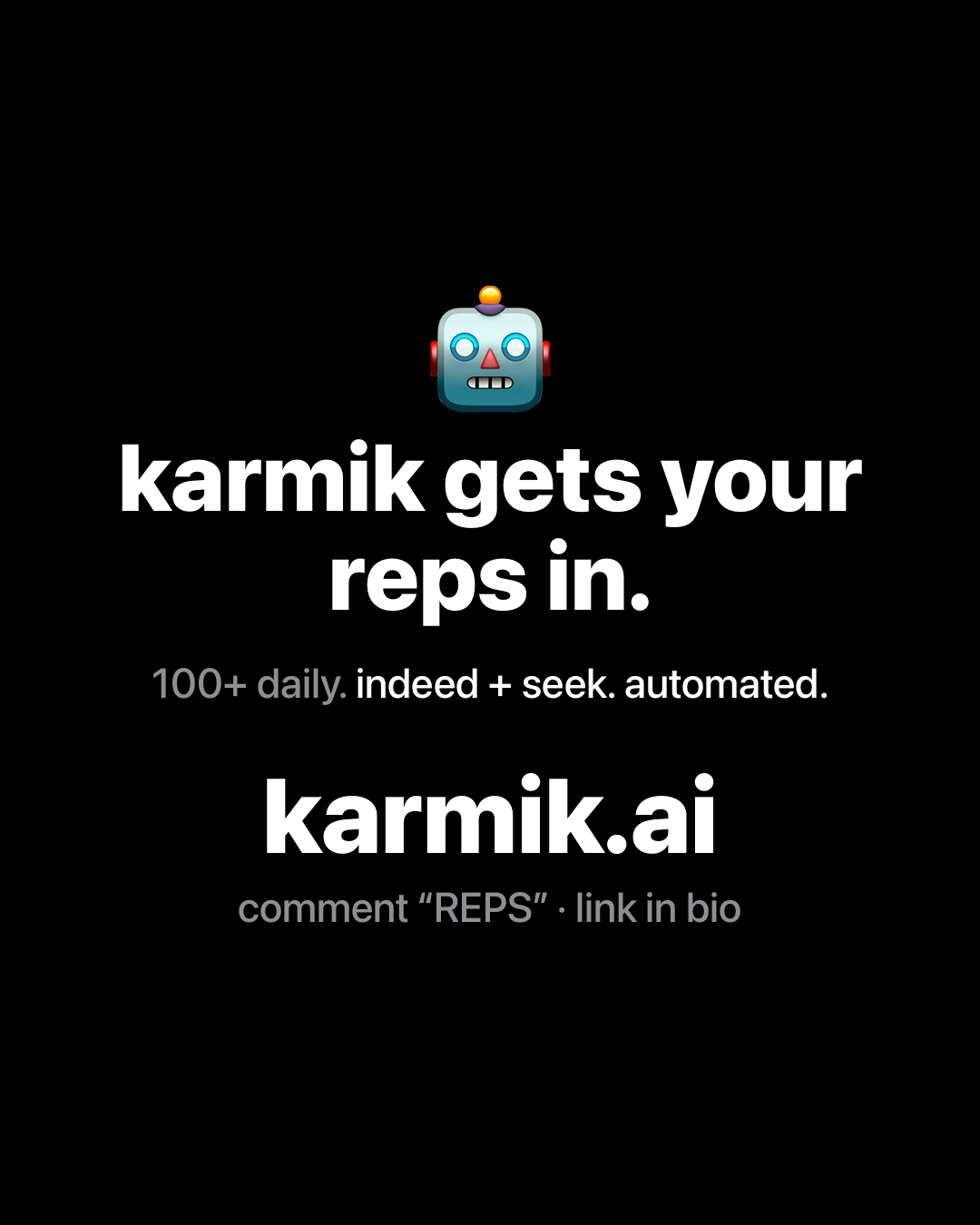
This is exactly what karmik.ai was built to do. It watches Indeed and Seek for roles that match your background. It writes a tailored cover letter for each one. Then it applies for you, daily, while you get on with your life. You get the reps in without the grind of doing each one by hand.
Kobe didn't become Kobe by taking five shots. He put in the volume. Your job search deserves the same approach. Start at karmik.ai.
Common questions
How many job applications should I send per week?
There is no single right answer, but most people send far too few. Reply rates are low across the board, so sending only a handful of applications a week gives probability very little room to work. Aiming for dozens of quality applications weekly is a more realistic approach for an active job search.
Does sending more applications mean lower quality?
Only if you are doing it by hand without any system. The goal is tailored applications at volume, where each one still speaks to the specific role. That is hard to do manually, which is why automation tools like karmik.ai exist. karmik writes a tailored cover letter for every role it applies to on Indeed and Seek, so quality does not drop as volume goes up.
What is the mamba mentality and how does it apply to job hunting?
The mamba mentality is the idea that mastery comes from obsessive repetition and putting in the work when no one is watching. In job hunting, it means treating applications as reps rather than precious individual events. Volume, consistency, and not waiting for perfection before you start.
Stop applying by hand
Karmik writes a tailored cover letter for every role and applies for you on Indeed and Seek. Start free with 10 applications, no card.